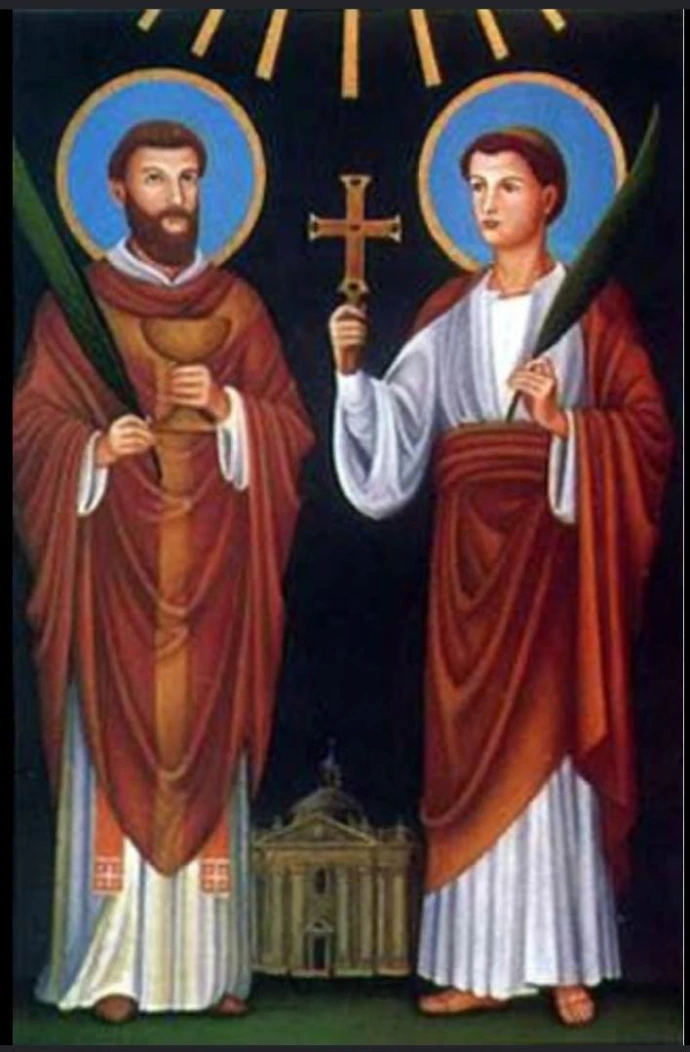
SAINTS MARCELLINUS AND PETER, MARTYRS
What debt do we owe to God, and what is our duty toward others?
The Apostle Paul tells us that we must give to everyone what they are due (Romans 13:6–8).
The Jewish leaders tried to trap Jesus in a religious and political conflict regarding the issue of taxes. The Jews hated foreign rulers and equally detested paying taxes to Caesar. Therefore, they posed a difficult, testing question to Jesus, hoping He would say something they could use against Him.
If Jesus had said it was lawful to pay taxes to a pagan ruler, He would have lost credibility among the Jews, who would have viewed Him as a coward and a friend of Caesar. On the other hand, if He had said it was unlawful to pay taxes, the Pharisees would have had a reason to hand Him over to the Romans and accuse Him of being a political agitator so that He could be arrested.
Jesus avoided their trap by using the example of a coin. In the ancient world, coins held great political power. Rulers would engrave their image and name onto coins, and in a way, the coin was seen as the property of the king. Wherever the coin was used, it signified the authority of that particular ruler. Since the Jews were using Roman currency, Jesus explained that what belongs to Caesar should be given to Caesar.
Jesus' Gospel regarding Caesar and God comes alive in the witness of Saints Marcellinus and Peter, who proved with their lives that earthly authority has its limits, but God is limitless in the obedience He is owed by man. They gave Caesar what belonged to Caesar with due respect, but they refused to give Caesar what belongs to God—namely, their faith. Through their martyrdom, they demonstrated the truth that man is created in the image of God; thus, his life, his heart, and his loyalty cannot be sold to earthly authorities. Therefore, their message emphasizes that faithfulness to God is eternal, even when the world demands the highest price.
Fr. Benjamin Maganga Bundala